
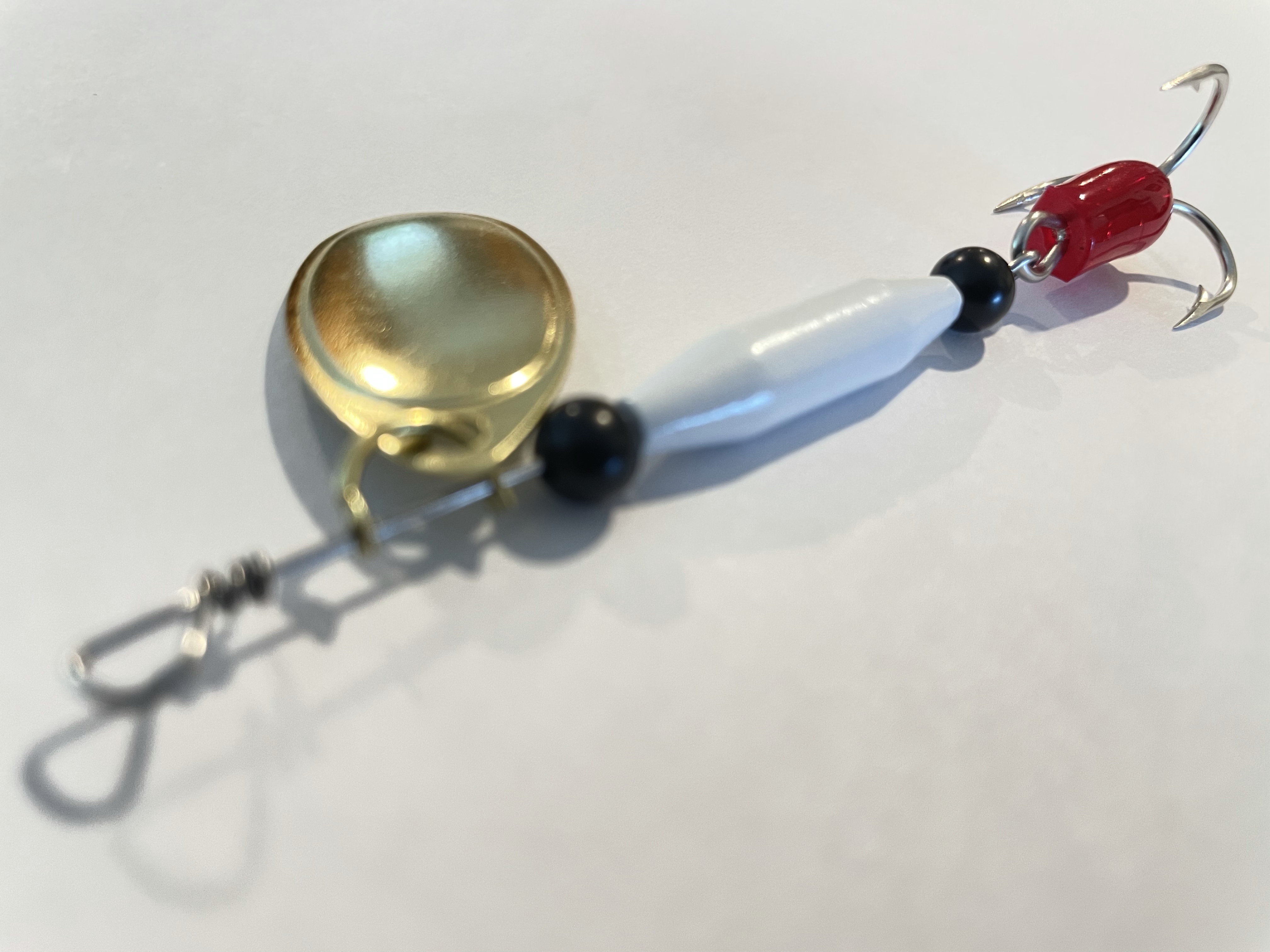
In-line Spinners: A Hit or Miss Design.
By Kane McDermott
Introduction
It’s no surprise that in-line spinner lures are sold in every tackle shop and department store with a fishing section. This is because they get results. Unfortunately, most new anglers will be turned away from these types of lures because they’ll buy a variety pack with the more intricate designs and extra color choices for $10 instead of buying the boring, unpainted, $4 single pack sitting next to it on the shelf. To be completely honest though, I did the same thing plenty of times when I was first starting out. For some reason I just refused to quit on casting these non-functioning in-line spinners. Luckily, it paid off when I finally picked a Yakima Worden’s Rooster-tail spinner
Finally! An in-line spinner that actually worked. With a subtle vibration coming from the blade of the lure all the way back to the handle of the rod, I could be assured that the lure was being as flashy and noisy as it should be, even when it was too far away to see. That feeling, the subtle vibration and increase drag on the retrieve, became my new standard/criteria for distinguishing “good” in-line spinners from the “bad” ones.
Trial, Error, & Success
After trying at least one lure from just about every brand that sells in-line spinners on the US market, I’ve decided that there are two clear champions; Yakima and Mepp’s. The in-line spinners produced by these companies each have their own pros and cons, but both consistently produce that subtle vibration/increased resistance that I believe is the key component to an effective in-line spinner.
Pros & Cons
| Brand | Pros | Cons |
| Yakima | -reasonably priced -great action -huge variety | -wire shaft bends easily -blade bends easily -action can be permanently ruined |
| Mepp’s | -great action -strong blade -great durability | -higher price point -less variety |
Note from the Author
I find the best weight for in-line spinners to be anything around the 1/4oz area, and the best size treble hooks being #2, #3, or #4, depending on the species you’re targeting.
My go-to treble hook sizes (by targeted species):
| Hook Size | Targeted Species |
| #2 Trebles | small trout & panfish |
| #3 Trebles | trout, bass, perch, & large cichlids |
| #4 Trebles | pike, bass, drum, & snakeheads |
Final Thought from the Author
As the creator of Lore & Lures and as the craftsman for all products sold by us, I’d like to have a moment of honesty and transparency. Despite working great for the first few casts, my Yakima lures would be ruined after one good smack against a rock, bridge, or even sometimes trees. Because of this, I switched to the Mepp’s Aglia series because their French blades could be struck with a hammer and still function properly as long as the rotating clevis doesn’t bend. However, I was still constantly searching for shops that had the exact size and style I wanted because I would lose at least one every week from either a snag or break-off. This prompted me to do my own research on the parts needed to imitate the action of the two lures, while also combining some of the perks from each into my own style. My final product, what’s currently in the store, has the price point of the Yakima, the durability of the Mepp’s, and also something neither of the two have; high-grade Mustad treble hooks.
 KANE ANTHONY